
Transcript
Announcer:
You're listening to GLC on ReachMD. This activity, titled “Talking Through Treatment: Patient–Clinician Dialogue on Perioperative Immunotherapy in Locally Advanced head and neck squamous cell carcinoma” is provided by Global Learning Collaborative.
Prior to beginning the activity, please be sure to review the faculty and commercial support disclosure statements as well as the learning objectives.
Dr. Luginbuhl:
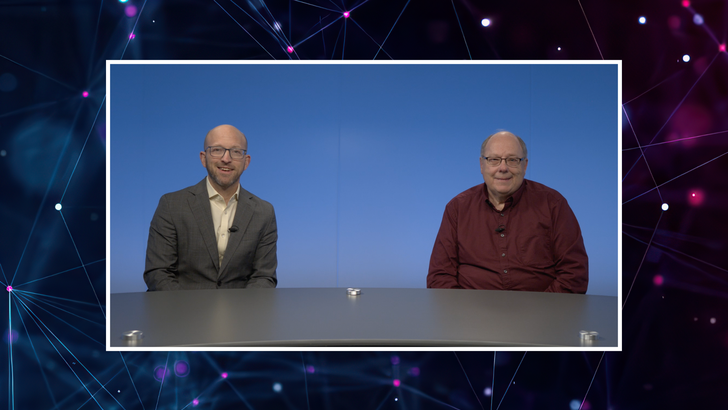
This is CE on ReachMD. And I'm Dr. Adam Luginbuhl. Here with me today in the studio is Stephen Heckman, a patient of mine with resectable, locally advanced head and neck cancer, who's considering perioperative immunotherapy. Welcome to the program, Stephen. It's nice to have you.
Heckman:
Thank you, Dr. Luginbuhl. Nice to be here. Can you explain to me why you would like me to receive immunotherapy prior to surgery?
Dr. Luginbuhl:
Sure. if you go back, let's see, maybe just two years ago, even three years ago, this wasn't even on the table. So this is a paradigm shift for us. We were essentially, you come in with this locally advanced disease, we'd talk about surgical resection followed by pathologically directed, or what the pathology shows, therapy afterwards. And over the past 10 years, we've been investigating what if we prime the immune system? Your immune system we know communicates with this tumor. That's a Nobel Prize discovery. So we have this knowledge and by recent discovery and now FDA approval, we are able to identify that if we can get your immune system to acknowledge that the tumor is present before we take it out, we actually activate a part of who you are, your immune system, to potentially start to fight this battle even before surgical resection.
Heckman:
What do you expect the tumor to do after receiving immunotherapy and before surgery?
Dr. Luginbuhl:
There's a wide range of possibilities, but we'll distill it down to three possibilities. The majority of patients actually are not gonna see a whole lot of change. If we look at the data from the trial KEYNOTE-689 that gave us FDA approval, a good majority of those patients, we didn't see that change at the pathologic stage as much as we saw the change two, three years down the road when we saw an improvement in the survival of patients like yourself. The second group, we could actually see a remarkable immune response where the tumor shrinks and reduces in size and even maybe goes away. And that is something that could very well happen. And if that does, that's wonderful. And we would talk about what that means. And then third group, in a really rare scenario, but definitely possible, and I've seen it, your tumor could get larger, it could amplify, it could grow, hyperprogression. And that's part of the risk of this that we have to talk about today as it relates to what our hopes are, but what also what our concerns are and what we have to be prepared for. Because hyperprogression is a real thing and it's rare, but it is something we should visit about.
Heckman:
Will I need to receive immunotherapy after surgery?
Dr. Luginbuhl:
There's an adjuvant component of the immunotherapy given with any necessary radiation or chemotherapy based on your pathology. So we take tumor out, we look at the pathology, if it has adverse features, things we don't like, badness, we need to treat with chemotherapy as we would, as we've done for decades. The new addition though, is that we would continue the immunotherapy provided you haven't had an adverse event, provided your tumor didn't have a hyperprogression. So those two negative things that we talked about that are the risks here, if they don't happen, well then yeah, we would continue the adjuvant arm of this after surgery.
Heckman:
What is my role in the treatment decision process?
Dr. Luginbuhl:
Anytime I have a patient in front of me, I see it as a shared decision. My job for you as a caretaker is to provide you with the risks and what the hopes are and the benefits. And at this point here as we look at your tumor in particular, you are a candidate. I do think that you'd be a very good candidate for this and if we did proceed with it, you'd have to weigh that and say, there's potential for an improvement in survival in two or three years, but there's also potential I develop an autoimmune disorder, or I could have hyperprogression. So part of shared-decision making is talking through those things and seeing what's right for you, for your care, for your tumor, for you as a person, and everything that goes along with that.
This has been a great discussion. Thanks so much for joining me, Stephen. And thanks again to our audience for tuning in.
Announcer:
You have been listening to GLC on ReachMD. This activity is provided by Global Learning Collaborative.
To receive your free CE credit, or to download this activity, go to ReachMD.com/CME. Thank you for listening.

 Global Learning Collaborative designates this activity for 0.50 contact hour(s)/0.050 CEUs of pharmacy contact hour(s).
  Global Learning Collaborative has been authorized by the American Academy of PAs (AAPA) to award AAPA Category 1 CME credit(s) for activities planned in accordance with AAPA CME Criteria. This activity is designated for 0.50 AAPA Category 1 CME credit(s). Approval is valid until 05/28/2027. PAs should claim only the credit commensurate with the extent of their participation in the activity.

